Saint Francis, AI, and the Future of Faith


What People Are Saying
“In Shadowing St. Francis, Jonathan invites readers on a pilgrimage of faith that is at once personal, philosophical, and profoundly hopeful. His narrative embodies the open-and-relational vision of a God who persuades through love rather than control, and his storytelling gives theology a human face.”
Thomas Jay Oord — Author of God Can’t and A Theology of Love
“Jonathan’s pilgrimage is an invitation to those navigating the uncertain space between deconstruction and what comes next. With honesty and grace, he shows us that the erosion of certainty isn’t a loss of faith but an opening toward something more spacious and true. This is a book for question-askers and those who suspect that the gospel might be wider and wilder than we’ve been told.”
Keri Ladouceur — Executive Director Post Evangelical Collective
“This book is what happens when theology steps out of abstraction and onto the road. Jonathan shows how faith can move beyond rivalry, beyond the mimetic pull toward power or certainty, into something freer—a consent to love, to mystery, to one another. It’s thoughtful, disarming, and exactly the kind of story the church needs right now.”
Jonathan Foster — Author of indigo: the color of grief

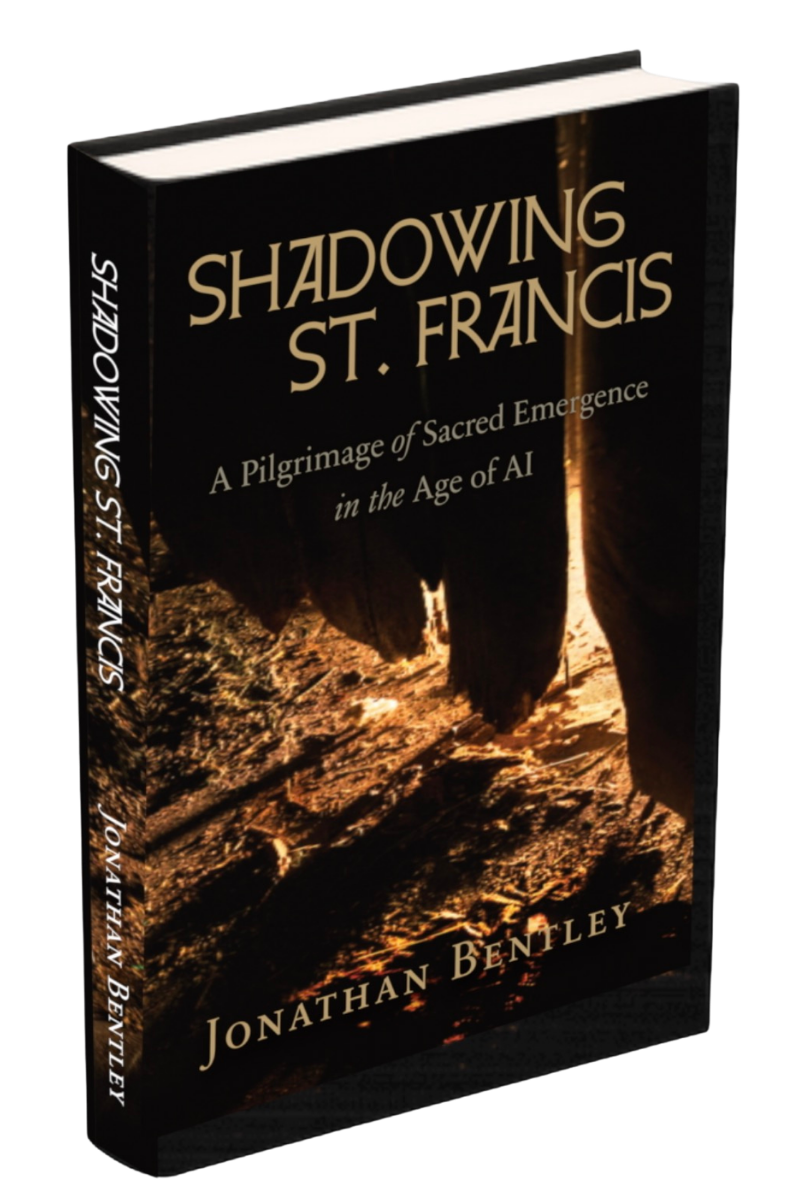
About the Book
What does a barefoot medieval friar have to say to an age of algorithms and anxiety? Far more than you might think…
By the time I laced up my boots to begin hiking in Italy, the tearing down was behind me. Fifty years of inherited evangelical certainty had run its course, leaving behind the wreckage of a faith built on the demand that God guarantee every outcome.
Shadowing Francis is where the reconstruction began.
Tracing his path across the hills of central Italy, an entirely different way of being in the world began to take shape—one that didn't treat uncertainty as a threat to be eliminated. Francis recognized that the need to control everything is ultimately a failure of trust. Real relationship requires room to breathe, room to risk, and the willingness to walk into an open future without a script.
Besides my three German hiking companions, I brought along an unexpected conversational partner: artificial intelligence. Used not as an oracle or an authority, but as an unsparing, egoless sounding board, it helped me interrogate a lifetime of theology without church politics or institutional defensiveness.
What emerged from that dialogue on the road was a vision of God centered not on unilateral force, but on love that calls without compelling. If the future is not already written, then creation is still unfolding, and we are not spectators waiting to be rescued. We are invited to pick up the quiet, everyday work of co-creating a world with a God who refuses to coerce it.
Shadowing Francis is a field report of what comes after deconstruction. It is written for anyone tired of defending a fragile certainty, ready to step onto the open road, and willing to trust the love that meets us there.